
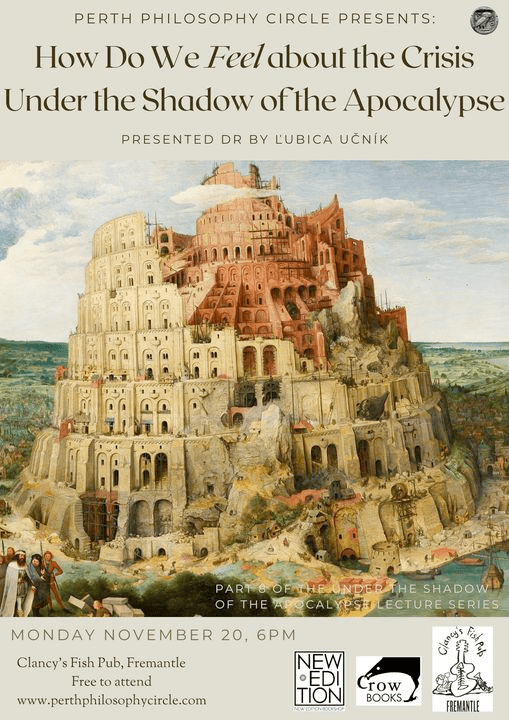
LECTURE 8: “How Do We Feel about the Crisis Under the Shadow of the Apocalypse”
Presented by Dr Ľubica Učník
November 20th
Harking back to our previous series, I want to reflect on a possible connection between apocalypse, crisis and hope in the name of utopia. I will leave open the question of whether it is even possible to make these connections in the name of utopia for our common future.
No tickets required, just come to Clancy’s at 6pm on Monday November 20th!
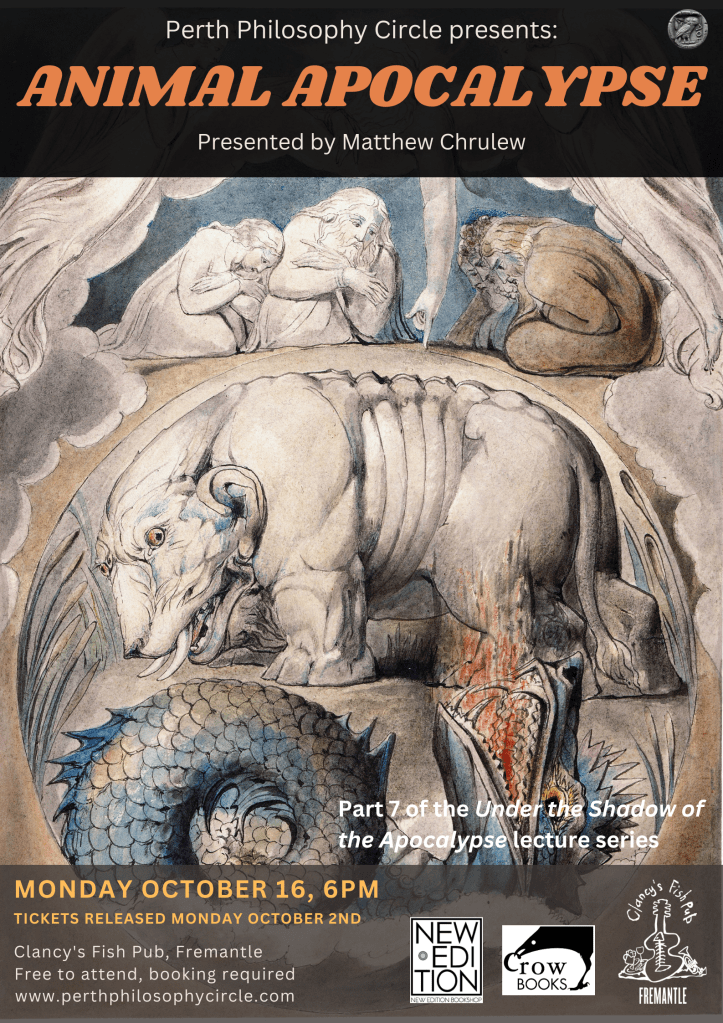
LECTURE 7: “Animal Apocalypse”
Presented by Dr Matthew Chrulew
October 16th 2023
If the biblical revelation is populated by symbolic animals—a dragon, the lamb, two beasts, four horses—today’s apocalyptic imagination is thoroughly ecological. Red lists of endangered species pile up alongside toxic pollution events and industrial agriculture ignominies as scientific signs of the end times. The deaths of an estimated half a billion wild animals in the climate-changed flames of the 2020 Black Summer bushfires was reported worldwide as an “animal apocalypse”: horrific catastrophe for some become terrifying warning for others. A cataclysmic future, already here, unevenly distributed across social and biological lines.
One thing these Anthropocene Armageddons reveal is the inextricable entanglement of all earthly life. Indeed, the apocalyptic tradition not only calls upon beasts as religious symbols but radically refigures dominant notions of humanity as excepted from the rest of animality. And numerous modern thinkers and writers have drawn upon this imagery for their concepts and stories of human annihilation and posthuman transformation. Drawing on scholarship in animal philosophy and the environmental humanities, this talk will bring together a range of animal apocalypses from philosophy, science, and science fiction to ask what they tell us about the ends of history, humanity and the world today.
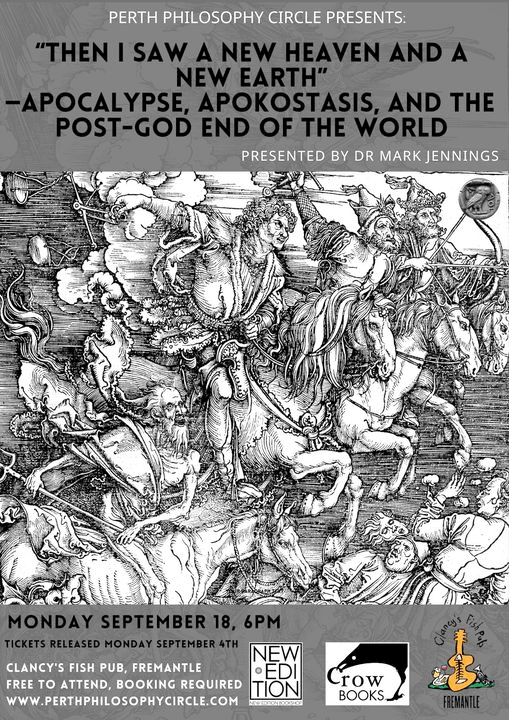
LECTURE 6: “Then I saw a new heaven and a new earth”—Apocalypse, apokostasis, and the post-God end of the world
Presented by Dr Mark Jennings
Apocalyptic literature emerged in ancient Judaism and Christianity in response to a particular problem – namely, the persistence of evil political systems and the existence of a benign, “good” God. The apocalyptic writers held an axiomatic belief not only in the existence of God, but that when the situation became irretrievably evil, this God would directly intervene and bring about the eschaton – the end of the age. Typically, these writers understood that the result would be “apokostasis” – generally translated “restoration – meaning that the world would be returned to its perfect state, when it existed in harmony sans corruption by decay and evil. In the so-called “secular age,” wherein Charles Taylor (among others) has posited that the conditions of belief have changed, we find ourselves left with the existence of corruption and decay, with no general expectation that anyone or anything is standing outside it all preparing to jump in and end it all – there is no widely held belief that anyone other than us can “save” us from our fate. Outlining the elements of the apocalyptic worldview, in this session we will draw these strands together to explore what the concept of apocalypse might even mean in the modern West, after the death of God.
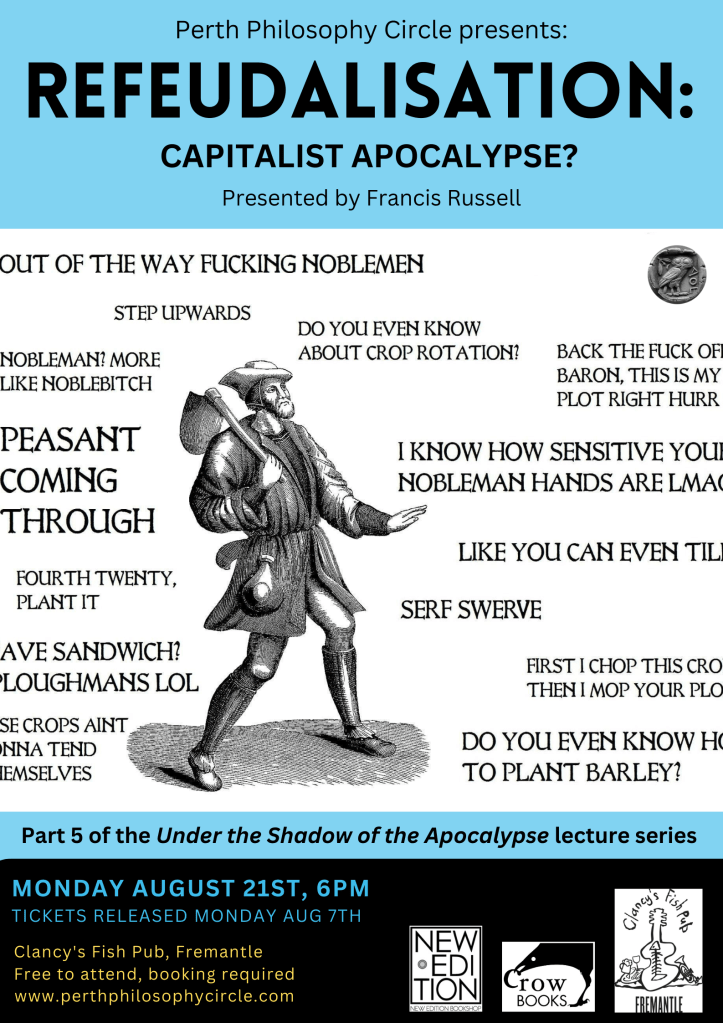
LECTURE 5: Refeudalisation: Capitalist Apocalypse?
Presented by Dr Francis Russell
August 21st
Emerging out of Jürgen Habermas’s landmark text, The Structural Transformation of the Public Sphere, “refeudalisation” referred to the privatisation of the media, public space, and other channels for political debate and discussion. This concept has only gained relevance with the emergence of a vast social media landscape, in which billions of users converse and share information through platforms owned by single individuals like Mark Zuckerberg.
More recently, political theorists like Jodi Dean have drawn on this concept to argue for a reconception of contemporary capitalism. For Dean, we must be open to the possibility of a material exit from capitalism, but an exit that opens into something worse: a new form of feudalism that unites the worst aspects of capitalist profit incentives, with new forms of technological serfdom and bondage. According to Dean, “digital platforms are the new watermills, their billionaire owners the new lords, and their thousands of workers and billions of users the new peasants.”
This talk will critically explore the notion of refeudalisation, both its origin and its contemporary usage, in order to think through its value for contemporary critiques of capitalism.
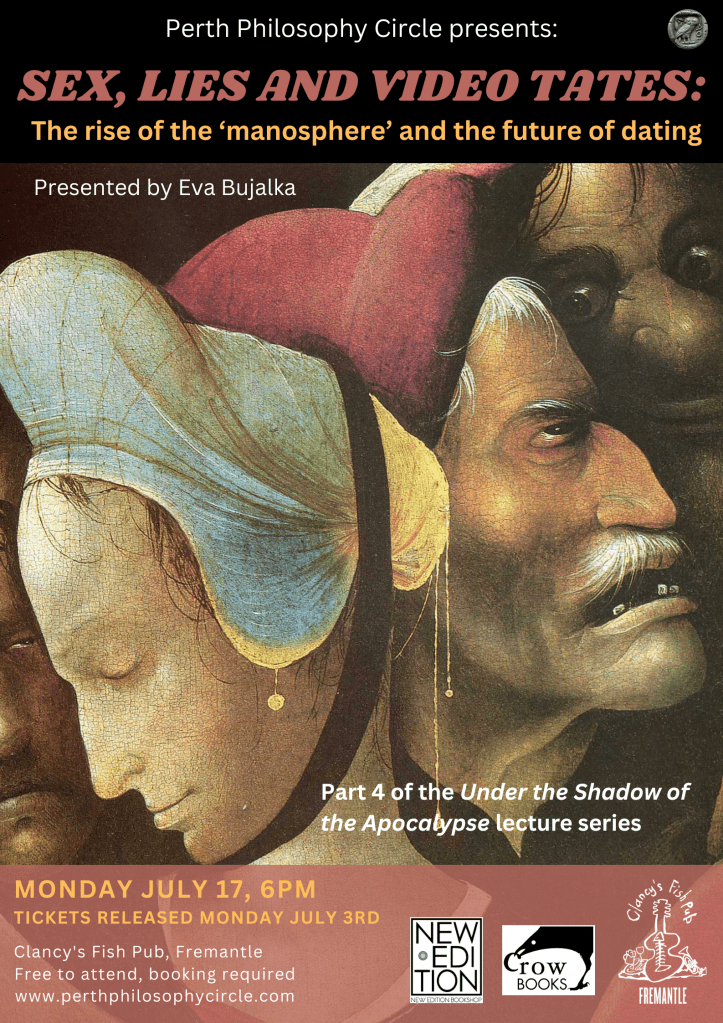
2023 Perth Philosophy Circle Presentation 4: Sex, Lies and Video-Tates: The Rise of the Manosphere and the Future of Dating
Date: July 17th
Presenter: Eva Bujalka
Since the early-2010s, the phenomenon of the “Manosphere” has gained increasing mainstream media attention, particularly for the misogyny and real-world violence that has been attributed to it. While the Manosphere arose as a reaction to feminism and female empowerment, it has also emerged in response to the alienating forces of neoliberalism. From its niche online beginnings, the Manosphere today is made up of a collection of disparate online men’s “support” groups and outspoken influencers who bemoan online dating, peddle self-help courses, and hawk testosterone-boosting supplements.
The mainstream media has tended to present the Manosphere as an unknowable evil, whose extremist male-supremacist ideas need to be sanctioned and punished. However, little attention has been given to making sense of the preconditions that led to the formation of their understanding of the world. Young men turn online to deal with the everyday agonies of rejection, failure, or loneliness, and the Manosphere offers an alluringly simple explanation of human relationships—one framed through crude biological theories, evolutionary psychology, and economic metaphors.
This lecture will examine the ways that these biological, evolutionary, and economic theories have been taken up as a framework through which to “objectively” make sense of human relationships. I will show how the Manosphere’s obsession with scientifically understanding, and thus manipulating, human relationships, has its origins in a broader intellectual tradition focused on synthesising the natural and social sciences. By exploring this history of ideas within the purview of the Manosphere, this lecture will problematise this turn to science to interpret the messy complexities of human relationships, where the phenomenon of human love is reduced to the expressions of “sexual market value” and reproductive success.
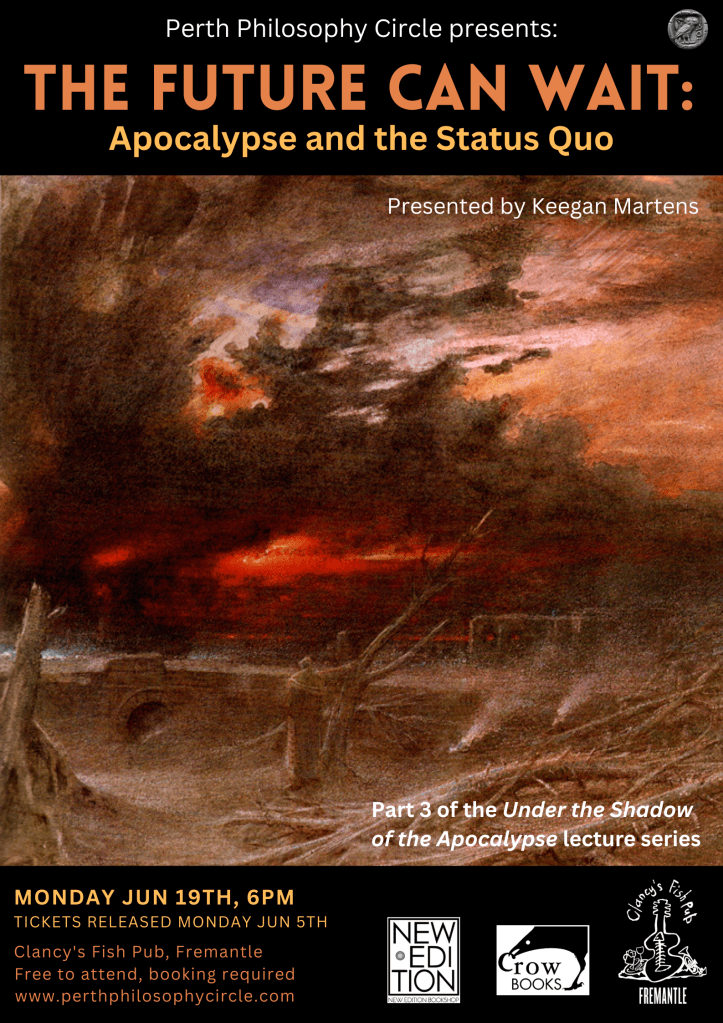
2023 Perth Philosophy Circle 3rd presentation: The Future Can Wait: Apocalypse and the Status Quo
Date: June 19th
Presenter: Keegan Martens
‘Apocalypse’ has come to mean an end to our current way of life. Much of contemporary fiction is devoted to considering this notion of apocalypse, both as an immanent threat and as a past event. Similarly, many works of non-fiction consider the possibility of a sudden end to our current epoch and how we might avoid or survive such a possibility. In short, we are in the midst of a popular obsession with apocalypse.
This talk will focus not on any particular apocalypse, predicted or imagined, but will instead consider the effects of our fixation on apocalypse. I will make the case that one key function of apocalyptic media is to re-enforce and justify the status quo. This mode of justification involves presenting social and political change as the cause of humanity’s downfall while simultaneously re-enforcing the inevitability of technological progress which will provide the solutions to both current and future problems.
Ultimately, I will claim, these views about the dangers of social change and the promise of technology are underpinned by a particular understanding of the future: one in which the future is simply another state of the universe, exactly like the present but at a later time. This understanding of the future reassures us with its predictability while acting as a self-fulfilling prophecy—if no other outcome is possible, why try to change it in the first place?
Tickets available from June 5th, click button below to reserve yours.
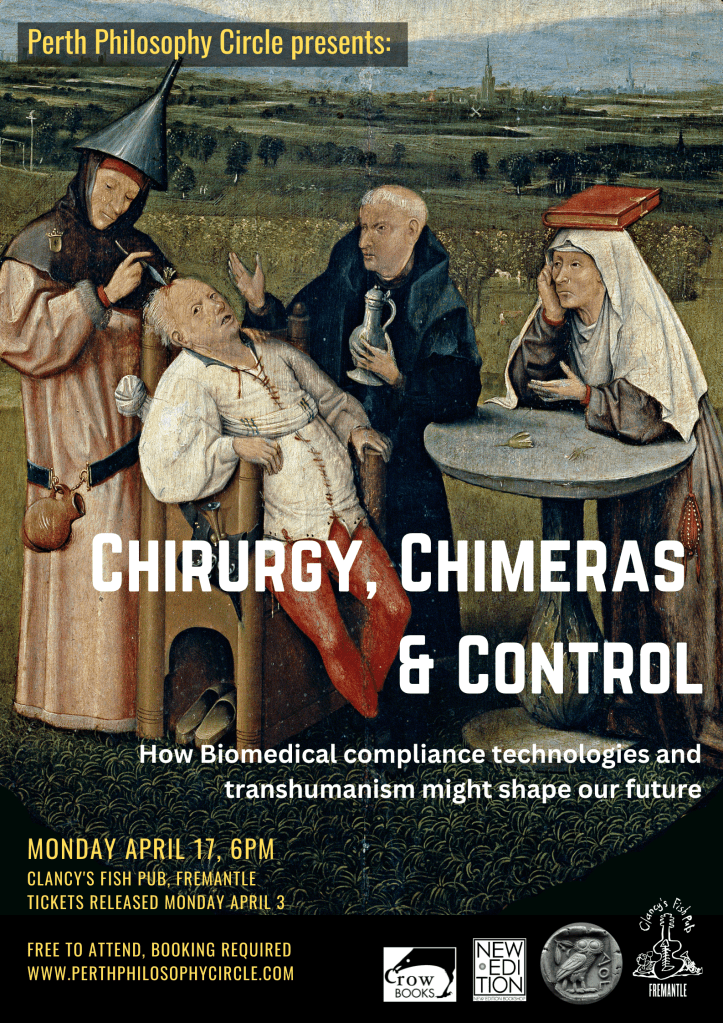
2023 Perth Philosophy Circle 2nd presentation: Chirurgy, Chimeras and Control: How Biomedical compliance technologies and transhumanism might shape our future
Date: 17th of April
Presenter: Charles Foster
The implacable march of biotechnological development has provided humanity, or at the very least those with wealth and resources, the power to overcome or control ever more diseases and disabilities. For many, this advancement has provided a ground upon which to imagine the possibility of a human life that may one day be freed from both physiological and mental suffering, and, in the most extreme cases, a future where death has been relegated from inevitable fate to mere personal choice. In this presentation I want to consider the concealed apocalyptic possibilities of emergent biotechnologies, following two distinct lines of enquiry to question the possible dangerous potential of our newfound capabilities. Firstly, I will examine how profit-driven medical insurance corporations have supported biotechnologies that aim to ensure pharmaceutical compliance and control, showing how this problematic development follows a longstanding, yet understated, influence that insurance companies have had on the development of modern medical treatments. I will follow this theme of biotechnological profit to consider examples of how private companies developing ‘neuroceuticals’—implanted technologies in the brain—can and have had nightmarish repercussions for those who make use of their products. My second line of discussion will be to consider biotechnologies that are being developed in order to make possible transhumanist dream of surpassing our natural capabilities and mortality. I will argue that, while we ought to be sceptical of the ability of biotechnology to actually make such a Promethean transformation possible, this project does serve to bring a range of fundamental questions into focus: Would cybernetics really allow for human flourishing and a better life? Is death simply a meaningless tragedy we should try to overcome? What kind of political oversight, if any, ought we to have over the development of, and access to, biotechnological enhancement? And finally, returning to the theme of biotechnological profit, who is it that we trust to responsibly develop and provide these possibilities?
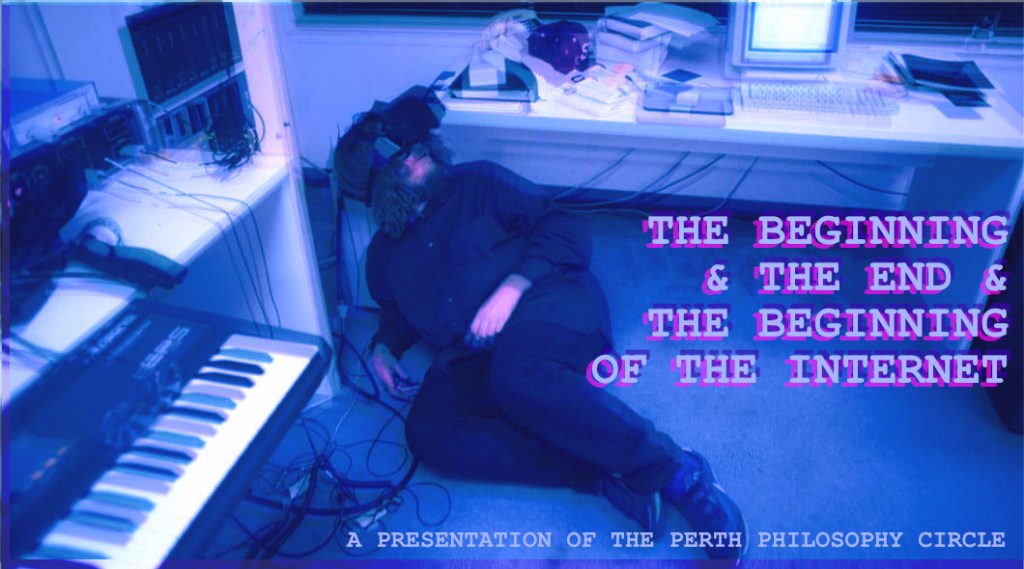
2023 Perth Philosophy Circle 1st presentation: The beginning and the end and the beginning of the Internet
Date: March 20th
Presenter: Andrew Hutcheon
Synopsis: Elon Musk buys Twitter, users rush for the doors and at least 50% of its staff are sacked. Facebook similarly sacks 1 in 8 of its global workforce in response to a decline in revenue and user activity. Misinformation is rampant, cybercrime is escalating and legislators are circling. Elsewhere, terms such as ‘digital detox’ – a term used to describe an intentional period away from an internet connection – and a general ambivalence towards the internet as it is currently developed should give pause to wonder whether the internet is reaching an end point, or else some kind of significant change worth noting. This presentation aims to provide an account of how we arrived at the present moment in the history of the internet and chart some possible futures, drawing upon a wide range of theory and material in the field, considering whether we have arrived at the beginning of the end, are continuing business as usual or something significantly weirder than we can anticipate.

It seems that despite the achievements of many civilisations, at the present, we live under the shadow of potential nuclear apocalypse. The re-emergence of conflict between global powers equipped with nuclear technology could lead to a global conflagration—a worldwide destruction with the potential to render our planet uninhabitable. But is our understanding of apocalypse limited to this brutal annihilation of the world? In this year’s lecture series, we will consider alternative ways to reflect upon our modern technologies and ways of thinking, that might go beyond destructive apocalyptic prospects: What potential futures we face that may not necessarily end in world-wide destruction but, rather, open up different possibilities for the radical transformation of human life as we know it.
At the present, we understand the term apocalypse as the irreversible destruction or the end of the world. But its original meaning was very different. Originally, the term apocalypse came from the Greek word apokálupsis. For the Ancient Greeks, apokálupsis meant ‘to uncover’. The term was later adopted in the title of The Book of Revelation ‘The Apocalypse of John’. Yet its meaning had changed. The apocalypse as uncovering became a revelation of the future, alerting us to a conflict yet to come, that would, without Christ’s salvation, lead to a destruction of the world. It was from this theological notion that our present concept of apocalypse as a destructive annihilation emerged.
In this year’s series, we will consider these various understandings of apocalypse to reflect upon a range of contemporary potential visions of the future. By questioning the ideas that support these prevalent visions, we hope to uncover the origins of these views of the future, while reflecting on the possible conflicts and destructive possibilities that remain uninterrogated.
Hence, in our new series, we will consider the apocalyptic undertones in our possible visions of the future through topics including: the idealism of the early internet and the perversion of this vision, emerging biotechnologies of control and transhumanism, how the idea of the ‘manosphere’ is transforming how relationships are understood, the dangers we face in our attempts to predict the future and our commitment to an unconsidered idea of progress, and other topics that consider the difficulty we face in thinking through our everyday connections to the world. Harking back to our previous series, we want to reflect on a potential connection between apocalypse, crisis and hope. In other words, the issue is whether it is even possible to hope for our common future.
Each lecture will last roughly 45 minutes to 1 hour and will be followed by questions and conversation.
We invite you to join us for a night of ideas, discussion and drinks as we ask what it means to be human in our contemporary world.
Though this series builds off of our previous series on Utopia and Crisis, no knowledge of philosophy is required; everyone is welcome.
Free to attend but tickets required. All refreshments and food are available for purchase from Clancy’s Fish Pub, Fremantle.
March through June presentation details:
March – Andrew Hutcheon – The beginning and the end and the beginning of the Internet
April – Charles Foster – Chirurgy, Chimeras and Control: How Biomedical compliance technologies and transhumanism might shape our future
May – Keegan Martens – The Future Can Wait: Apocalypse and the Status Quo
June – Eva Bujalka – Sex, Lies and Video Tates: The rise of the ‘manosphere’ and the future of dating
 PERTH PHILOSOPHY CIRCLE