
2025 Lecture 5: Death and the Modern
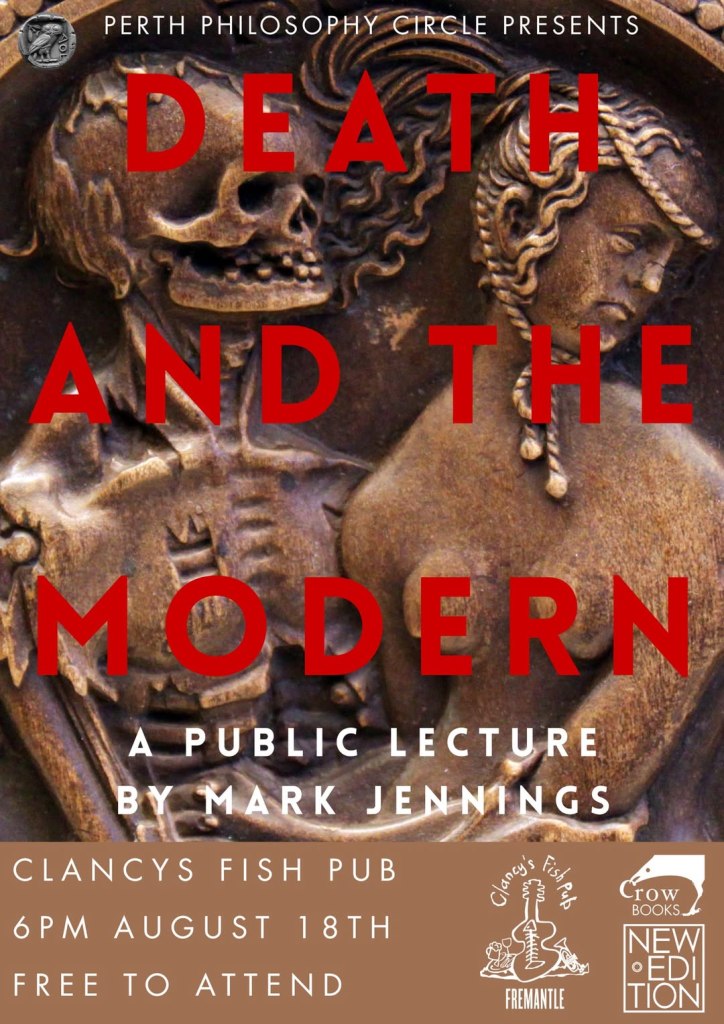
Everyone dies. To be is – eventually – not to be.
And yet – we have long sought to transcend this ultimate limitation. Human beings are blessed – or perhaps, burdened – with the facility to seek meaning and understanding in all experience, including death, and have done so for a very long time. It is simple to presume that the history of human reflection on death is a story of progression from primordial supernaturalism to modern materialism – simple, and false.
Tracing that history at breakneck speed, all the way to the chain of contingency that has produced the present, we will reckon with the significance of what Charles Taylor calls the “immanent frame.” How has secularism and the concomitant changes in the conditions of belief transformed our imaginings of the limitations of human existence? What fractured dreams may come, when many of us hold to a moribund materialism, while others have found once firmly held assurances fragilized?
2025 Lecture 4: AI Slop: Post-truth Digital Subjectivity
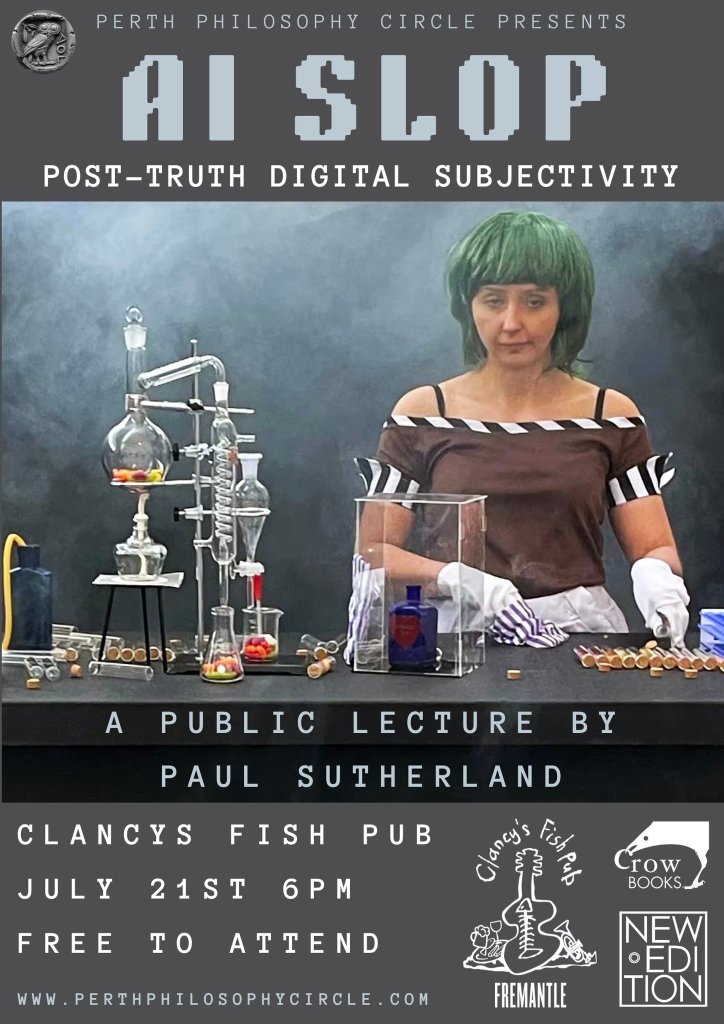
Within the space of three years, Generative AI had rapidly evolved from novel proofs of concept to a cultural saturation point where its usage in workplaces, schools, traditional media, and digital platforms seems inescapable.
ChatGPT is being used as an assignment writer by some, and an oracle or therapist by others. AI generated images, despite often depicting far-fetched scenarios, are becoming increasingly photo-realistic and have been published by numerous traditional media outlets around the world, featured in political campaigns, and disseminated prolifically enough online that a whole new pejorative term has emerged to describe it—AI Slop. The pejorative nature of this term is clearly at odds with the effortlessness of its proliferation and its apparent wider cultural embrace.
This presentation examines why AI Slop became so widely normalised, situating it within the broader media conditions that enabled the ‘post-truth’ era to emerge. It argues that the post-truth era, where the factuality of information becomes less relevant to people than its affective resonance, precisely provides the right environment for AI Slop to be culturally accepted, and, in turn, AI Slop has become the hallmark aesthetic of the post-truth era.
2025 Lecture 3: An Ecology of Truth in a Fractured World
Filter bubbles, AI and privatisation have meant that the notion of truth is having a particularly hard time. In this lecture I’ll explore how truth is generated by an ‘ecology’ of human and non-human elements; in the process illustrating how contingent (and political) ‘claims to truth’ tend to be. I argue that understanding truth as generated by such an ecology helps to identify certain common experiences that can re-centre the process of truth telling and collective action.
The lecture will draw heavily on the work of Hannah Arendt, and contain reflections on Jurgen Habermas, Naomi Klein, Eli Pariser and Gilles Deleuze. Of course we’ll discuss the distance between Trump and truth; but we’ll also travel from philosophy to follower counts, from Tik Tok to technological determinism, and hopefully after all that, end up with a better idea about what we could do to nurture truth telling in a fractured world.
2025 Lecture 2: Fascism or Bonapartism?

Since Donald Trump’s victory in 2016, the lumpen-intelligentsia has engaged in a breathless debate over whether Trump—and the insurgent far right more broadly—is fascist. This argument has become ubiquitous across the political spectrum, with different tendencies offering different solutions to the global fascist threat.
For the centre, the solution is to rally against extremism tout court and mount a defence of existing institutions and the “rule of law”. For the left, the solution is to form popular fronts and confront fascist violence head on, including in the streets. Predictably, the incessant debate sparked a pedantic back and forth over the extent to which contemporary far right populism is actually similar to the historical exemplars of Nazi Germany and Fascist Italy.
This presentation argues that the historical analogy of fascism is more limiting than revealing. Instead, this talk applies a different historical analogy to make sense of our present conjuncture: Bonapartism. First appearing amidst the revolutionary upheaval of 18 th and 19 th century France, Bonapartism is a much more common (albeit just as dangerous) reactionary response to intractable political and social crisis. Surveying different critical theories of fascism and Bonapartism—including analysis by Karl Marx, Wilhelm Reich, Domenico Losurdo, and Henri Lefebvre—the talk concludes with the tactical and strategic implications that follow from each heuristic.
2025 Lecture 1: Technological Somnambulism and the Problematic Body in 2020s
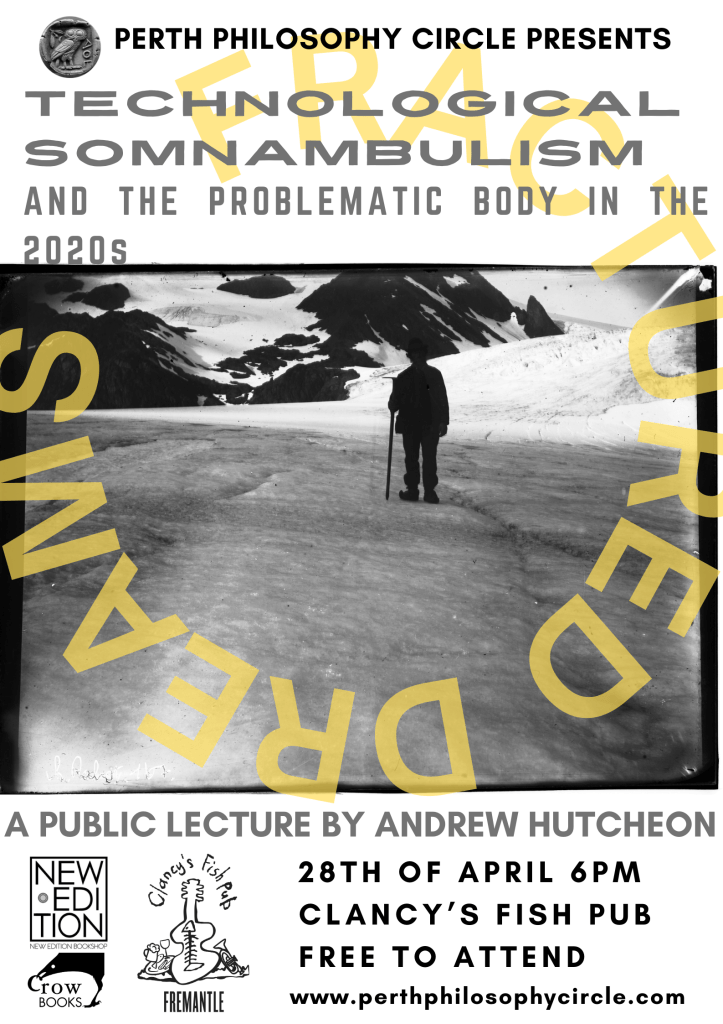
We live in an era where technological development has been largely handed over to
corporations and the narrative oscillates between utopian promises and existential threats. Yet beneath these dominant discourses, there is a view that we have fallen asleep at the wheel, or having, as Langdon Winner memorably put it, ‘technological somnambulism’. From social media to large language models, our responses to new technologies have been lagging; the new devices and software fully adopted long before we realise the trouble we are in.
These concerns established, this talk chooses to centre its inquiry on the role of embodiment within technological politics. As Matthew Crawford argues in the domain of both craft and automobility, the direction of technological development is often actively hostile to the exercise of embodied capacities and our ability to make decisions. Similarly, in an earlier phenomenological argument, Don Ihde argued for attention to be paid to the ‘here-body’, the experiences of the body that cannot be replicated by virtual facsimiles. These arguments are opposed by the desire of many powerful technologists wishing to achieve a ‘Singularity’ of transferring minds into computers, and so the body has thus become a problem.
This need not be the case, however, and falling into despair at this latest crisis point will not assemble meaningful alternatives that offer paths of resistance. Nor can the path forward be based purely on critique, individual action or clever policy proposals. In following Crawford, as well as theorists such as Ivan Illich and Donna Haraway, an opportunity arises in thoughtful and practical engagement with technology, in developing alternative ways to design and make these artefacts that acknowledges the value of embodiment, work and our capacity to self-govern.
2025 Lecture Series: A Crisis of Thinking: Reflections Upon a Fractured World
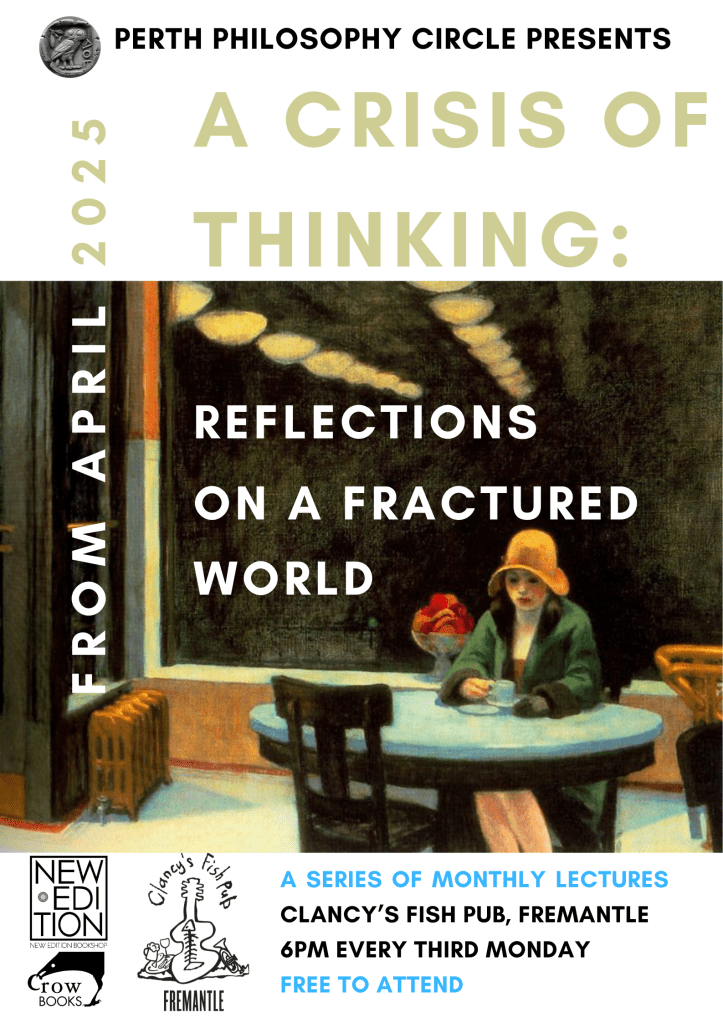
The present is full of crises: political, economic and climatic to name only a few. In the face of these overwhelming challenges it has been suggested that we are prone to “crisis thinking”, in which panic leads us to act rashly, or in the worst case to not act at all, and instead avoid the tasks before us. Some symptoms of this avoidance are the rabbit holes, echo chambers and filter bubbles that we discussed in the previous series.
In this series, we will reflect upon our present thinking about our troubled world, not as the psychological notion of “crisis thinking” but instead as a crisis of thinking. We draw upon the meaning of crisis as a crossroads at which change is possible in order to consider the crisis of thinking as an opportunity to think differently. We seek to approach the problems that confront us in a different way; from a perspective of considered reflection rather than panic.
 PERTH PHILOSOPHY CIRCLE