
Lecture 7: Death of God in the age of nihilism

November 18th, 2024
Abstract: To think through the implication of the death of God (or otherwise) in the age of nihilism, I will recall Hannah Arendt’s claim (taken from Werner Heisenberg) that the “modern age, with its growing world-alienation, has led to a situation where man, wherever he goes, encounters only himself”.
Following from her claim, I will try to walk the path of the rabbit into his hole. So, I will start with a2+b2=c2, followed by E=mc2, concluding with kpb wcy xz, thereby reflecting on a possibility and interpretation of the apocalypse in our nihilistic world.
Lecture 6: Attention, please!
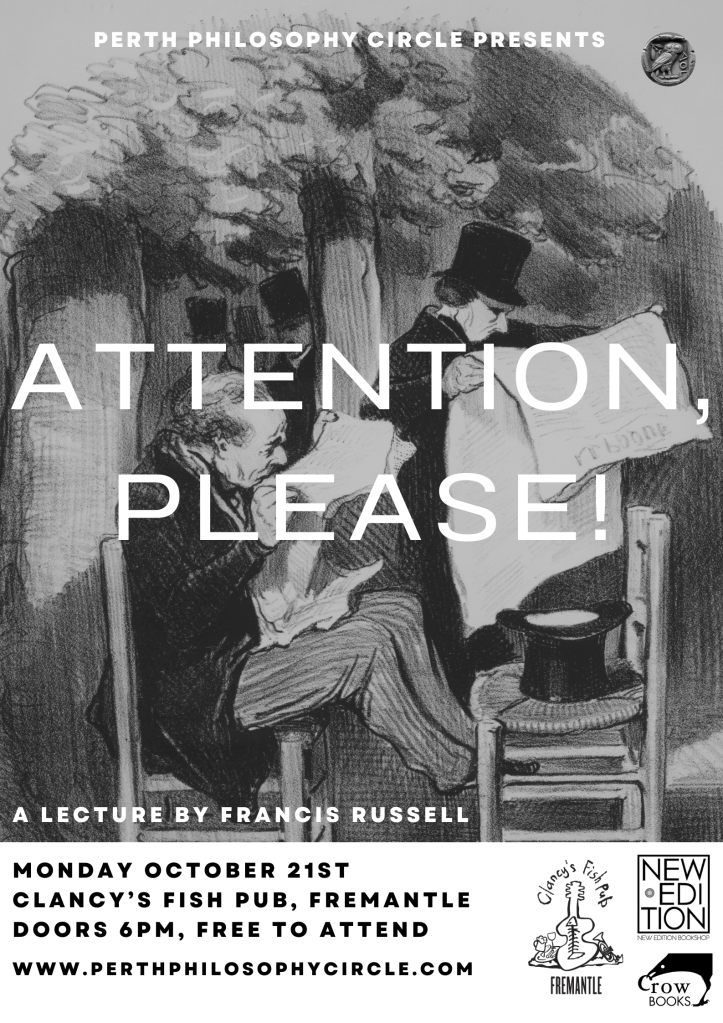
October 21st, 2024
Abstract: Popular discourse warns us that we are living through a crisis of attention. From scientific studies claiming to have proven that attention spans are in decline, to politicians warning of our children’s addiction to social media, one cannot avoid the narrative that digital media is robbing us of our capacity to maintain a steady presence in the world. In response to such calls to alarm, wellness gurus offer training in mindfulness, management specialists prothletise the productivity benefits of flow, and right wing influencers preach the gospel of stoic discipline and focus. No matter what you read or who you trust, the injunction to escape distraction and to pay attention feels inescapable.
But what if the truth was more complicated? What if, instead of diminishing our ability to pay attention, contemporary digital technologies were transforming attention itself? What if, rather than simply disappearing, attention is mutating and pluralising into different modes. If this were the case, would a solution as simple as returning to older forms of attention make us any freer than we are today?
In order to explore these questions, this talk will examine the work of a range of philosophers and critical theorists—such as Friedrich Nietzsche, Walter Benjamin, Christian Marazzi, Sianne Ngai, and Alenka Zupančič—and a range of contemporary digital medias—the likes of TikTok, chatbot therapists, ambient music, and noise cancelling headphones, amongst others. Neither an apology for the technological domination of the lifeworld, nor a hagiography for the self-focused bourgeois subject, this talk will explore today’s antinomies of attention.
Lecture 5: Left wing melancholia
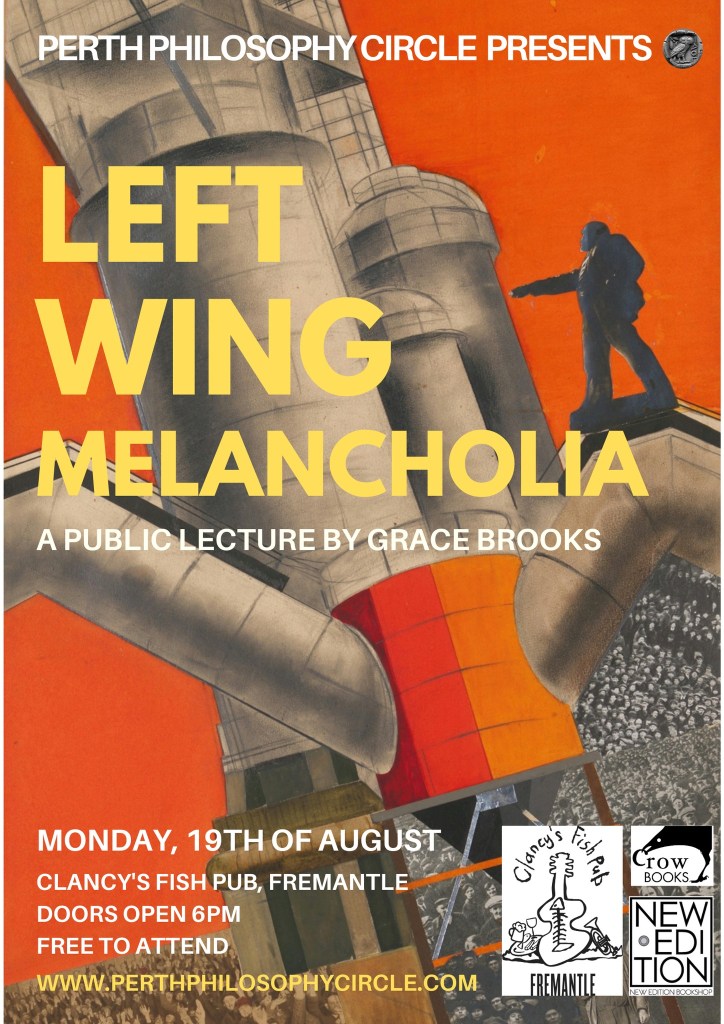
August 19th, 2024
Abstract: In the 20th century, leftist movements articulated their political projects with reference to the future. A utopian orientation towards the future imbued socialism with a progressive teleology, rupturing the notion of cyclical time associated with pre-modern societies. Although some tendencies on the modern left still contain a residual sense of futurity and utopianism—most clearly in post-work politics—the collapse of the Soviet Union engendered a left whose temporal orientation became directed towards a lost past. Through the concept of “left-wing melancholia”, this talk analyses the effectiveness of leftist politics when it becomes unable to move on from its vanquished and tragic history. Influenced by the pathological conception of melancholia described by Freud—who contrasted melancholia to the healthy process of mourning—left-wing melancholia has been used as a pejorative by several political theorists. Notably, Wendy Brown argued that a melancholic attachment to the lost socialist projects of the 20th century encouraged a fatalistic left, enamored with its own impossibility and failure. Conversely, this paper defends the notion of left-wing melancholia, arguing that a left which adequately mourns the defeated socialist movements of the twentieth century would be tantamount to an acceptance of capitalism: there is no alternative. By “de-pathologising” melancholia—and refusing to let go of the lost object of socialism—an anti-capitalist politics can be reactivated and redeemed.
Lecture 4: Dead ends

July 15th, 2024
Abstract: “Finding myself,” “becoming the best version of myself,” “being true to myself” – this language, whether those using it are aware of it are not, is grounded in an idea of an essential, (if not necessarily fixed) self that is both discoverable and achievable (if often tantalisingly beyond reach). Charles Taylor explores the genealogy of this idea in his Sources of the Self, beginning with Romantic expressivism of the Late Renaissance and emerging in late modernity in an “ethic of authenticity,” wherein the objective is not the achievement of greatness, but the self-discovery. But this is not the only game in town. Another strand, most notoriously associated with Michel Foucault, is predicated upon the absence of a true self. In this view, a person is constituted only by the historical, cultural, and social conditions in which they find themselves, with individual subjectivity subject to structural forces largely beyond individual control. Perhaps when people use expressions like “I need to reinvent myself,” this discursive understanding is in view.
In this lecture, I argue that many of us actually hold these two, basically contradictory views, at the same time. More importantly, both positions are, arguably, dead ends, arriving either at a deterministic fatalism, and/or the tyranny of the self-entrepreneurial neoliberal project. Is that all there is? Maybe. But we conclude by reasoning together with Socrates, who accepted his limited knowledge while remaining determined to act in the knowledge that he possessed. If we are to find another way, this might be a good place to start.
Lecture 3: Competition, counting and gibberish
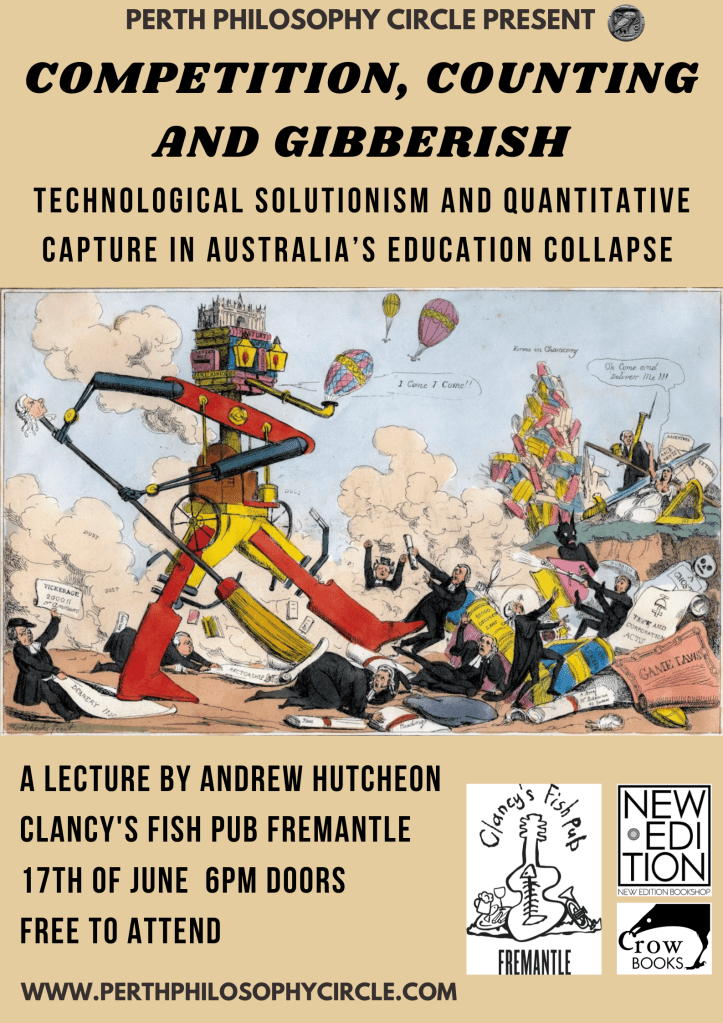
17th of June 2024
Abstract: From teacher shortages to declining literacy, the Australian education system faces multiple crises. What is going on? And what is to be done? In this lecture, I propose that there are two often overlooked and interlinked problems at the bottom of this rabbit hole – the quantification of education and the race to adopt educational technology nationally (edtech). I argue here that Evgeny Morozov’s conception of technological solutionism is a pertinent way to view large parts of the problem, in that it isn’t just the adoption of technology itself that is the problem but the belief that some form of technology and quantification is always the solution to the problem. This presentation turns to the work of Neil Postman, who started as a high school teacher but later turned towards communication and media studies, to provide a counterpoint to the now-dominant technological solutionism found in Australian education. The main line of Postman’s argument rebukes what I call ‘quantitative capture’, or the reorientation of our expectations around education towards quantitative measures and mindsets. Postman delivers a defence of the civic value of education and critiques the conjoined madness of quantitative capture and technological solutionism. This presentation reviews and revises this technology-oriented critique of education, arguing that both the principles and application of technology in Australian education have corrupted the meaning and outcomes of education.
Lecture 2 2024: Alien Prophets and Machine Gods: Yearning for a Secular Heaven
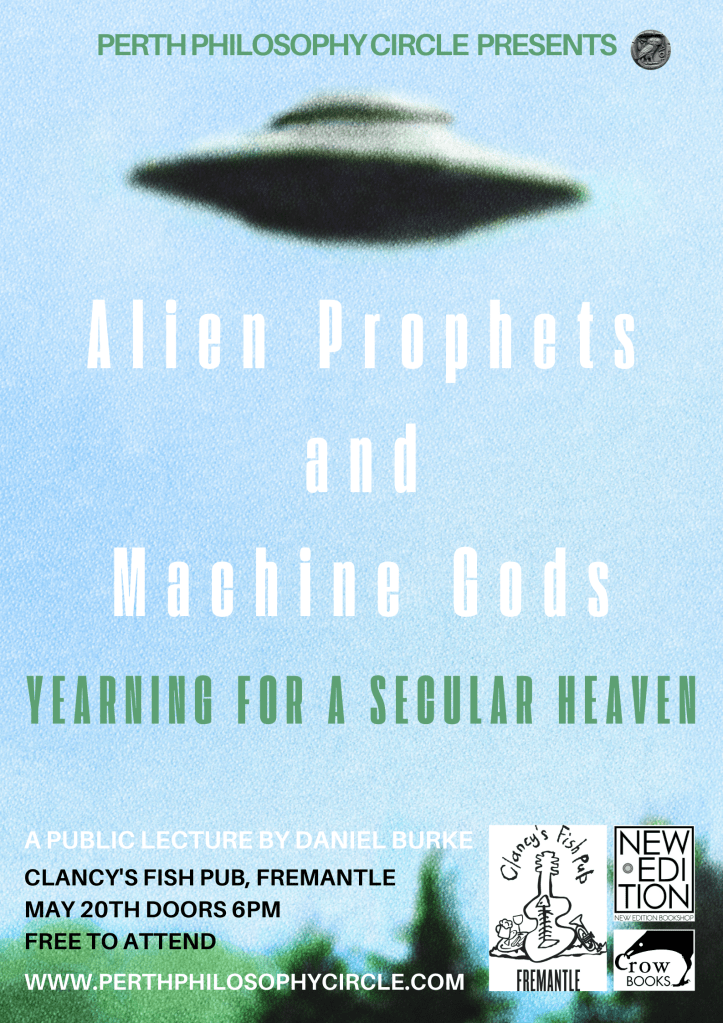
20th of May 2024
Abstract: The French philosopher August Comte (1798-1857) believed that a modern ‘purely descriptive’ science was destined to characterize our thinking in general. Comte argued that we were on the threshold of a new age, where we would put aside our ‘childlike’ need for deeper, more meaningful explanations of the world and who we are. Where do we stand, nearly two hundred years after Comte’s death? The medium of technology has helped to spread positivistic scientific thinking to all corners of the globe, where it permeates nearly all aspects of our lives. Yet it seems that our desire for something more than mere description remains. Indeed, it is not only that the old religions stubbornly persist, but that entirely new ‘theological’ movements have sprouted in the scientific age. I will consider two: belief in a UFO mythos, and AI-technological utopianism. As I shall show, each of these movements seeks to provide us with a narrative that helps to make sense of who we are, where we are going, and what we ought to hope for. Moreover, it is my contention that these movements are not expressions of the remnants of pre-scientific thinking that we have yet to eradicate from our collective consciousness, like some kind of ‘recessive-gene.’ Rather, they are both a reaction to, as well as an outgrowth of, the dominance of narrowly scientific ‘rationality’ at the expense of a broader form of reason that is grounded in human experience.
Lecture 1 2024: Sapere Aude – Dare to Think: In Defence of the Enlightenment

15th of April, 2024
Abstract: “In this paper, I want to reflect on Jesus’ cry on the cross as recounted by Mathew 27:46: “Eli, Eli, lama sabachthani… My God, my God, why hast thou forsaken me?” How can we think about our present if a possible God’s response were – ‘My son, I was never with you in the first place,’ thereby marking the abolition of transcendence that defines our scientific age. What would our response to this absence of transcendence be?
Hannah Arendt calls this lack of response thoughtlessness. How, then can we think about this supposed thoughtlessness?
Albert Schweitzer defined thoughtlessness as “a culmination” of the “overorganization of our public affairs”. Transcendence is now transformed into set of positive rules that should guide us in the world without God.
In order to think the issue of thoughtlessness, the lecture will be framed as an answer to Hannah Arendt’s claim about thought and thoughtlessness:
… a reconsideration of the human condition from the vantage point of our newest experiences and our most recent fears. This, obviously, is a matter of thought, and thoughtlessness – the heedless recklessness or hopeless confusion or complacent repetition of ‘truths’ which have become trivial and empty … What I propose, therefore, is very simple: it is nothing more than to think what we are doing.”
Lecture Series 2024 – Daring to Think for Oneself

Perth Philosophy Circle Presents the 2024 Lecture Series:
Daring to Think for Oneself: Rabbit Holes, Echo Chambers and Filter Bubbles
“When I use a word,” Humpty Dumpty said in rather a scornful tone, “it means just what I choose it to mean – neither more nor less.”
“The question is,” said Alice, “whether you can make words mean so many different things.”
–– Lewis Carol, Through the Looking Glass, Chapter 6.
As we have done in the previous series, we think it is important to draw attention to another aspect of the ‘crisis’ of meaning in our age. This year’s focus, then, is on ‘rabbit holes’, ‘echo-chambers’, or ‘filter bubbles.’ To start with the term rabbit hole – supposedly originating from Alice in Wonderland –, a rabbit hole describes the strange path a person can go down when they spend too much time ‘researching’ a subject via internet sites, finding themselves off the beaten path. And there’s no telling where they might end up. In contrast to this lost-in-the-rabbit-hole ‘researcher,’ an echo chamber refers to a group collectively expressing the same views back at themselves (made even easier online), thereby reaffirming what they already think to begin with. The third term, filter bubbles, is interesting to contemplate, because it supposedly describes the way internet algorithms shape what we are shown based on our previous searches, therefore locking us, ‘forever,’ in the same loop of information. We thereby become trapped ‘in a bubble,’ created and reinforced by algorithmic filters.
It might seem, from the above descriptions, that the problem with thinking for oneself in the world today is that we must navigate between these seemingly different, opposing threats. Either on the one hand, there is the threat of departing altogether from ‘common sense’ and ‘reasonable opinion,’ and falling into ‘conspiracy thinking’. Or, on the other hand, there is the threat of being stuck in an echo-chamber, or a bubble, only hearing what you already want to hear, from people you already agree with.
Yet, the question is if this ‘story’ is really so simple. Perhaps, reflecting on Immanuel Kant’s article “What is Enlightenment?,” [Was ist Aufklärung?], we can discuss the above story differently. Writing in 1784, Kant issues a summons to the general readership in the form of Sapere Aude! – dare to think for yourself or dare to be wise. What does his demand amount to? Kant’s call is a recognition of the importance of autonomy – auto | nomos, to give reason to oneself instead of relying on heteronomy, reasoning of others in authority. Yet we can only start thinking for ourselves if we discuss public matters with others. But how are we to think for ourselves, if we are stuck in the rabbit holes or echo chambers, reinforced by algorithmic filter bubbles? According to Kant, the public use of reasoning means to be able to discuss matter of interest from different standpoints and not accept one way of looking at things. It is imperative for fostering the greater understanding of the common world. We all should use our critical thinking, instead of accepting the views of authority uncritically.
As Kant asks of us in his article, we should use our own reasoning and specifically not abide by what one should think. Echo chambers only reinforce what one already believes, preventing us from thinking through presuppositions that we have inherited. In the ‘post-truth’ era, where the empirical scientific-method has shaped how we understand truth, arguments, facts, reasoning, etc., such that evidenced-based reasoning is the only way to understand what is real, what is there left to think about? And how can we think through these ideas without taking a negative or positive stance on them? When we say someone is in a rabbit hole, is this a negative claim that they no longer listen to reasons that others present? Does a rabbit hole lead only to echo chambers?
To reflect on these issues, in this series, we will present different points of view related to how we understand the meaning of reasoning today.
Each lecture will last roughly 45 minutes to 1 hour and will be followed by questions and conversation.
We invite you to join us for a night of ideas, discussion and drinks as we ask what it means to be human in our contemporary world.
Though this series builds off of our previous series, no knowledge of philosophy is required; everyone is welcome.
 PERTH PHILOSOPHY CIRCLE